
Shopping Cart
There are no more items in your cart




























- Elanus Parts
- Derailleur Hanger Knowledge Base
- 2 likes
- 0 comments
- what derailleur hanger do I need, which hanger fits my bike, hanger compatibility, correct hanger for my bike, replacement derailleur hanger, Shimano or SRAM hanger, UDH compatible frame
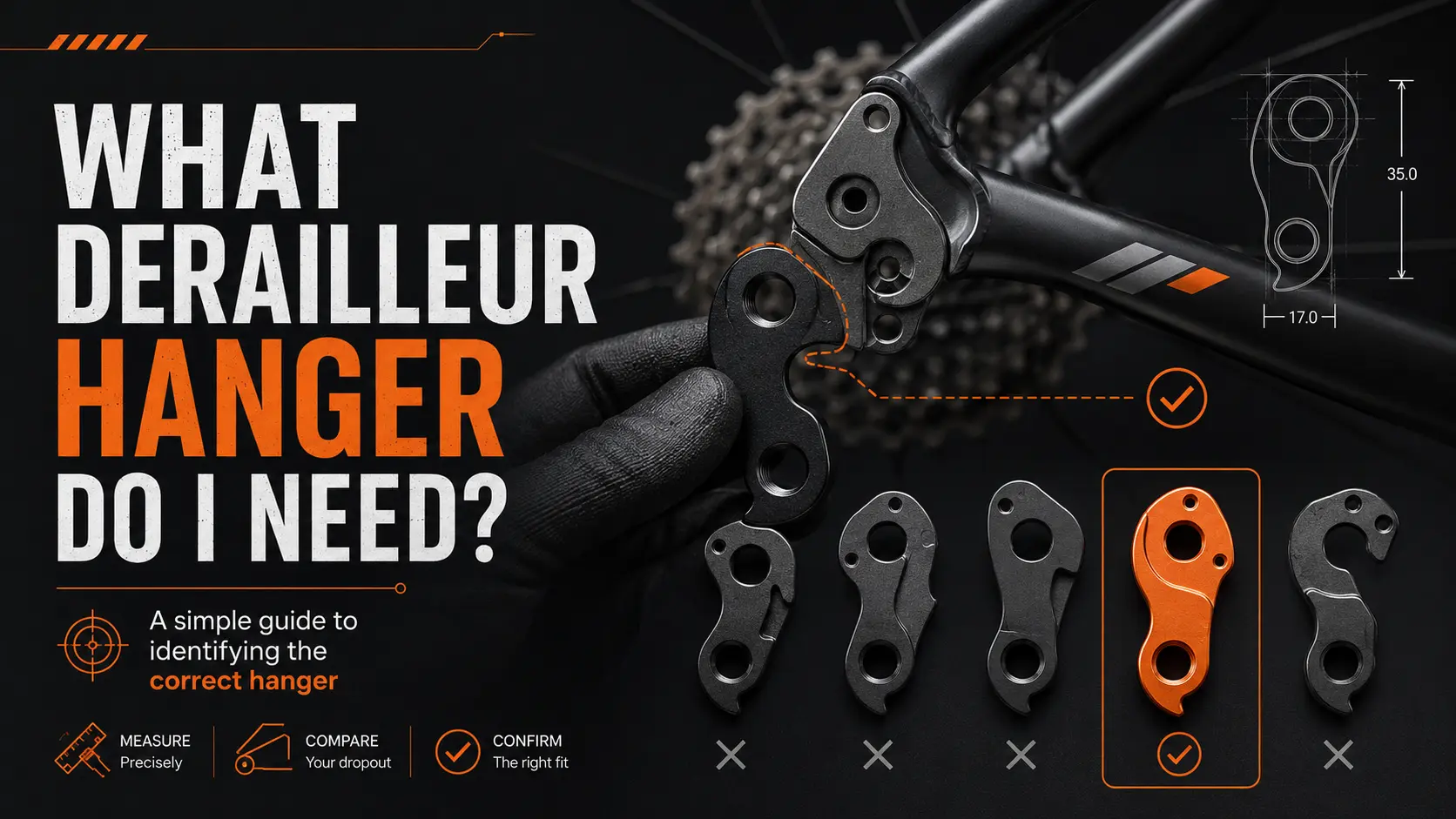
Quick answer: the derailleur hanger you need is determined mainly by your bicycle frame, not by whether your rear derailleur is Shimano, SRAM, mechanical or electronic. To find the correct replacement, confirm the bike model and frame generation, check whether the frame uses SRAM UDH or a traditional hanger, identify the rear axle system, and compare the original hanger’s mounting details.
If your bike uses a SRAM Full Mount derailleur, such as an Eagle Transmission derailleur, it does not use a separate derailleur hanger. The derailleur mounts directly to a frame built around the UDH interface.
Below is a practical compatibility checklist that will help you answer the question: “What derailleur hanger do I need?”
The Frame Determines the Hanger
A derailleur hanger connects a conventional rear derailleur to the bicycle frame. Because the hanger must fit the frame’s dropout precisely, its compatibility is normally determined by the frame design.
The following details can all change which hanger a bicycle uses:
- bicycle brand and exact model;
- model year or frame generation;
- carbon or aluminium frame version;
- quick-release or thru-axle rear wheel;
- axle diameter and, on some designs, thread pitch;
- number and position of mounting screws;
- inside or outside frame mounting;
- standard, Shimano Direct Mount, UDH or Full Mount system.
This is why two bicycles carrying the same model name may still require different hangers. A manufacturer may update the dropout, axle standard or frame construction while continuing to use the same model name.
Does the Derailleur Brand Determine Which Hanger You Need?
Usually, no. A traditional derailleur hanger is selected for the bicycle frame rather than for the derailleur brand.
For example, the same standard-mount hanger can normally support a compatible Shimano, SRAM, Microshift or Campagnolo rear derailleur. Changing from a mechanical derailleur to an electronic derailleur does not automatically mean that the frame needs a different hanger.
However, there are important exceptions:
- Shimano Direct Mount: some frames and hangers were designed for a Shimano derailleur with its B-link removed.
- SRAM Full Mount: Transmission and compatible Full Mount derailleurs attach directly around a UDH-compatible frame interface and do not use a separate hanger.
- Unusual or proprietary systems: a small number of frames use manufacturer-specific mounting arrangements.
Therefore, do not choose a hanger simply because a product title says “for Shimano” or “for SRAM.” First match the hanger to the frame and then confirm the derailleur mounting type.
Derailleur Hanger Compatibility Decision Tree
1. Does the derailleur mount directly around the rear axle?
If the derailleur clamps around both sides of the frame at the rear axle and there is no separate hanger between the derailleur and frame, the bike probably uses a Full Mount derailleur.
In this case, you do not need a replacement derailleur hanger. You must confirm that the frame has a UDH-compatible hangerless interface and that the derailleur is compatible with that interface.
2. Is the frame designed for SRAM UDH?
UDH means Universal Derailleur Hanger. A UDH hanger has a standardised shape, but it is not compatible with every bicycle frame. The frame must have been designed specifically for the UDH interface.
Common signs of a UDH system include:
- a large circular hanger interface around the rear axle;
- a hanger that rotates slightly around the axle when loosened;
- a UDH logo or marking on the hanger;
- an M12 × 1.0 UDH-compatible rear axle;
- the bicycle manufacturer listing the frame as UDH compatible.
If the frame is confirmed as UDH compatible and uses a conventional derailleur, choose a compatible SRAM UDH derailleur hanger.
If the same frame uses a Full Mount derailleur, the UDH hanger is removed and the derailleur attaches directly to the frame interface.
3. If It Is Not UDH, You Need a Frame-Specific Hanger
Most older bicycles and many current road, gravel, trekking, city and mountain bikes use a traditional frame-specific derailleur hanger.
For these bikes, match all of the following:
- overall shape;
- mounting side;
- number of fasteners;
- fastener position;
- axle hole diameter;
- inner step or contact surface;
- derailleur mounting position;
- thickness and frame contact area.
A hanger that looks similar from the outside may still be incompatible because the frame-facing side, axle interface or screw position is different.
4. Check the Rear Axle System
The rear wheel attachment is one of the fastest ways to eliminate incompatible hangers.
| Rear axle system | Typical identifying feature | Why it matters |
|---|---|---|
| Quick release | Thin skewer, usually with a lever | Normally uses a smaller open or round axle slot |
| 10 mm axle | Larger solid or bolt-on axle | May look similar to quick release, but requires a different axle opening |
| 12 mm thru axle | Large axle passes through the frame and hub | The hanger may form part of the axle interface or contain the axle thread |
| SRAM UDH | 12 mm thru axle with a standardised UDH frame interface | Fits only bicycle frames specifically designed for the UDH system |
Important: on some thru-axle systems, the derailleur hanger also contains the axle thread. In these cases, the correct thread pitch is essential. Two hangers may have an almost identical outer shape but use different axle threads and therefore are not interchangeable.
5. Count the Mounting Fasteners
Traditional hangers may be held in place by one, two, three or more screws. Others use a separate locknut, retaining ring or the rear axle itself.
Count only the fasteners that attach the hanger to the frame. The large threaded hole used to mount the rear derailleur is not a frame fastener.
The fastener count is useful for narrowing the options, but it is not enough by itself. Many completely different hangers use the same number of screws.
6. Check Which Side of the Frame the Hanger Mounts On
A derailleur hanger may sit:
- on the outside of the dropout;
- on the inside of the dropout;
- partly inside and partly around the frame;
- in a clamp-style arrangement around the dropout.
The mounting side affects the hanger’s thickness, step shape and alignment with the cassette. An outside-mount hanger cannot normally be replaced by a similar-looking inside-mount version.
7. Confirm Standard Mount or Shimano Direct Mount
Most current conventional rear derailleurs use a standard hanger mount. A Shimano Shadow derailleur may include a removable link, commonly called a B-link, between the derailleur and the hanger.
A Shimano Direct Mount hanger positions the derailleur differently and is intended to connect to a compatible derailleur after the B-link has been removed.
Standard and Direct Mount hangers for the same frame may have different shapes. Check the existing arrangement before ordering. Do not assume that “direct mount” means SRAM UDH or SRAM Full Mount; these are different systems.
What Does Not Usually Determine Hanger Compatibility?
The following details are often useful for understanding the bicycle, but they normally do not identify the hanger by themselves:
- 26, 27.5 or 29-inch wheel size;
- 8, 9, 10, 11 or 12-speed drivetrain;
- mechanical or electronic shifting;
- rear derailleur cage length;
- cassette tooth count;
- road, gravel, MTB or e-bike classification;
- black or silver hanger colour;
- CNC-machined or cast construction.
For example, a 12-speed Shimano derailleur does not require one universal “Shimano 12-speed hanger.” The required hanger is still primarily determined by the bicycle frame.
Can You Choose a Hanger by Bike Brand and Model?
Bike brand and model are a useful starting point, but they are not always sufficient.
The same model may use different hangers because of:
- a change between model years;
- different carbon and aluminium frames;
- rim-brake and disc-brake versions;
- quick-release and thru-axle versions;
- regional specifications;
- mid-year frame updates;
- different suppliers or production batches.
You can begin with the derailleur hanger list by bicycle brand, but always compare the candidate with the original part and the frame interface before ordering.
How to Confirm the Final Match
Once you have narrowed the selection, compare the replacement product images with the removed original hanger.
Check both sides and pay particular attention to:
- every outer edge and curve;
- the axle opening;
- the shape of the frame-facing step;
- all screw holes;
- small tabs or locating pins;
- the derailleur mounting hole;
- the thickness of each contact area.
Do not compare only the visible side while the hanger is installed. Many of the most important compatibility features are hidden against the frame.
For a complete photo-based identification process, read our separate guide on how to identify a derailleur hanger.
What If the Original Hanger Is Missing?
A missing hanger makes identification more difficult, but it may still be possible.
Collect the following information:
- bicycle brand and exact model;
- approximate model year;
- frame material;
- clear photos of the right rear dropout from both sides;
- rear axle and any markings printed on it;
- photos of the derailleur mounting area;
- any remaining screws, nuts, washers or broken pieces.
The shape of the empty frame interface often reveals whether the bicycle uses UDH, a threaded thru-axle hanger, an inside-mount hanger or another frame-specific design.
Can a Universal Hanger Fit Any Bike?
No. Most derailleur hangers are frame specific.
There are two products commonly described as universal:
- SRAM UDH: a standard hanger that fits only frames designed for the UDH interface.
- Emergency universal hangers: temporary solutions intended to help a rider continue a journey or reach a workshop.
An emergency hanger should not automatically be treated as a permanent replacement. For normal use and correct shifting geometry, install the proper frame-compatible hanger whenever one is available.
Common Hanger Selection Mistakes
- Buying by derailleur brand: Shimano or SRAM branding usually does not determine the frame interface.
- Using the bike model without checking the year: one model name may cover several frame generations.
- Comparing only one side: the hidden side may have a different step, recess or locating tab.
- Ignoring the axle: QR, 10 mm, 12 mm and UDH systems are not interchangeable.
- Assuming UDH fits every modern bike: the frame must specifically support UDH.
- Confusing UDH with Full Mount: UDH is a hanger standard; Full Mount derailleurs install without a separate hanger.
- Ordering by colour: finish and colour do not confirm compatibility.
- Assuming a matching outline is enough: mounting thickness, screw position and frame contact surfaces must also match.
Information to Send for Professional Identification
When you cannot confirm the correct hanger, send:
- the bicycle brand, model and approximate year;
- photos of the removed hanger from both sides;
- photos of the frame dropout without the hanger installed;
- a photo of the complete bicycle;
- rear axle measurements or visible axle markings;
- all broken pieces, screws, nuts and washers placed together.
Clear, perpendicular photos on a plain background are more useful than photos taken from an angle or with the derailleur still covering the hanger.
Final Compatibility Checklist
Before ordering a replacement, confirm every relevant item:
- □ The bicycle model and frame generation are correct.
- □ The frame is traditional, UDH or hangerless Full Mount.
- □ The rear axle type and diameter match.
- □ The axle thread matches where the hanger contains the thread.
- □ The hanger mounts on the correct side of the frame.
- □ The number and position of fasteners match.
- □ The inner step and frame contact surfaces match.
- □ The derailleur mounting system is correct.
- □ Both sides match the original hanger.
If one of these details is different, do not force the hanger into the frame. Even a small incompatibility can prevent correct wheel installation, damage the frame interface or place the derailleur in the wrong position.
Frequently Asked Questions
What derailleur hanger do I need for a Shimano derailleur?
You normally need the hanger designed for your bicycle frame, not a Shimano-specific hanger. Confirm the frame model, axle system and mounting type. Some Shimano derailleurs can also use a Direct Mount arrangement, so check whether the derailleur is installed with or without its B-link.
What derailleur hanger do I need for a SRAM derailleur?
A conventional SRAM derailleur normally attaches to the frame-specific standard hanger. If the bike uses a UDH-compatible frame, a conventional SRAM derailleur can use a UDH hanger. SRAM Full Mount and Transmission derailleurs attach directly to the UDH frame interface and use no separate hanger.
Is SRAM UDH compatible with every bicycle?
No. UDH fits only bicycle frames designed specifically for the UDH interface. It cannot be fitted safely to a traditional dropout simply because the bicycle uses a 12 mm thru axle.
Can the same bicycle model use different derailleur hangers?
Yes. A bicycle model may use different hangers depending on the model year, frame material, brake type, axle standard or frame generation. Always confirm the original hanger and dropout design.
Does wheel size determine the derailleur hanger?
No. Wheel size alone does not determine hanger compatibility. A 26-inch, 27.5-inch or 29-inch bicycle can use many different hanger designs depending on its frame and axle system.
Does a 12-speed derailleur need a special hanger?
Not necessarily. The number of drivetrain speeds usually does not determine the traditional hanger shape. The frame interface and derailleur mounting system are more important. Full Mount 12-speed systems are a separate exception because they require a compatible hangerless frame interface.
Can I identify the correct hanger if the original is broken?
Often, yes. Place all broken pieces together and photograph both sides. Also photograph the empty frame dropout, rear axle and any remaining fasteners. These details can usually narrow the compatible options.
Should I buy a hanger that only looks approximately correct?
No. The outer outline, axle opening, screw positions, inner step, thickness and frame contact surfaces should all match. A hanger that is only approximately similar may not align the derailleur correctly or may not fit the frame at all.
Find the Correct Replacement
Browse our range of replacement derailleur hangers or narrow the selection using the bicycle brand directory.
If you are still unsure, contact Elanus Parts and send clear photos of the removed hanger and frame dropout. Our team will help compare the mounting features and locate the correct replacement.
About Elanus Parts: Elanus Parts is a European bicycle parts specialist supplying derailleur hangers, drivetrain components, thru axles, chainrings and e-bike parts. We help riders and bicycle workshops identify compatible replacement components for thousands of bicycle models.
Comments (0)