
Shopping Cart
There are no more items in your cart




























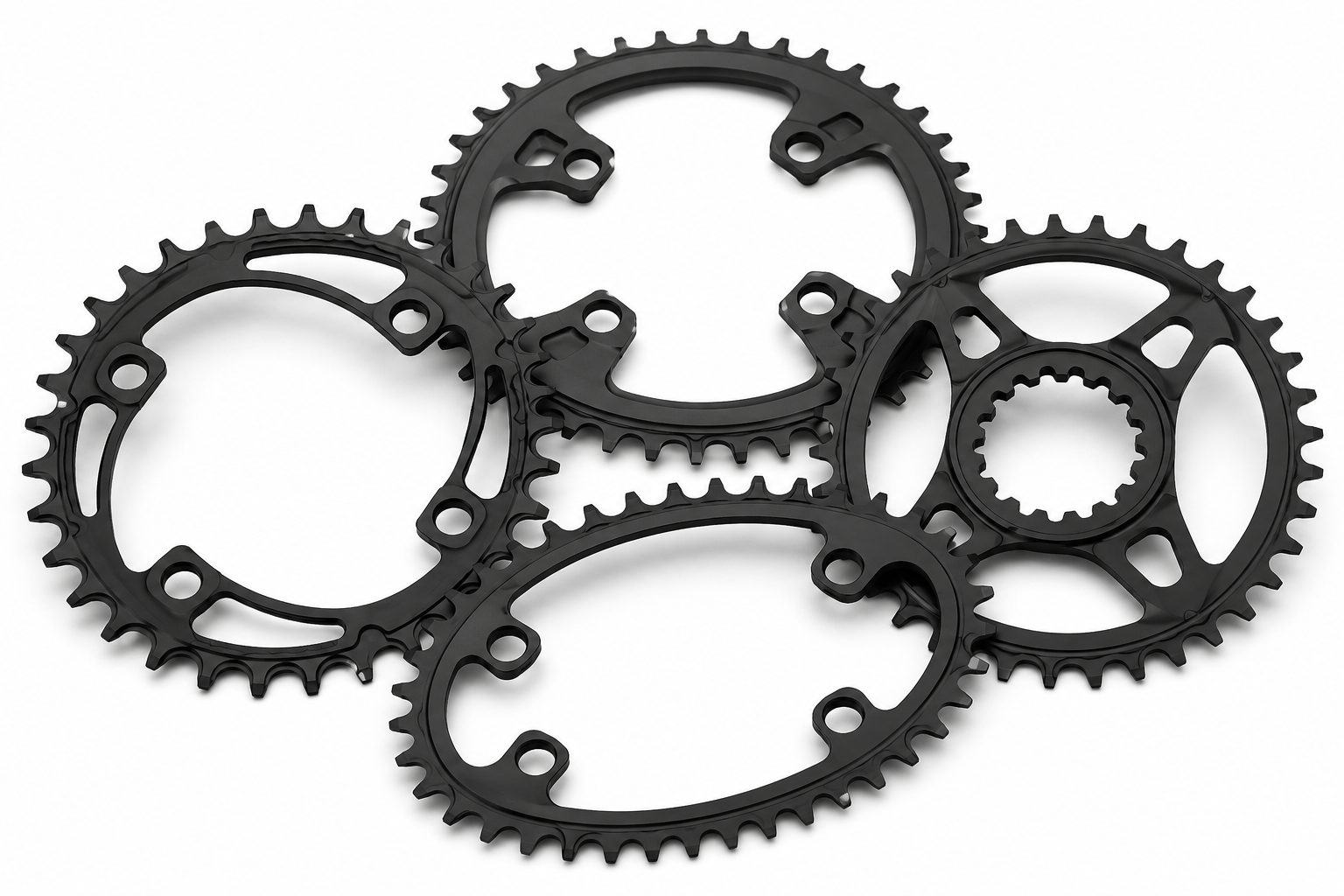
Chainrings might look simple, but they have a big effect on how your bike climbs, accelerates and holds speed. Choosing the right chainring size and mounting type can make your bike feel easier on steep climbs, faster on flat roads, or more secure on rough trails.
At Elanus Parts we help cyclists identify and replace chainrings every day and have worked with thousands of MTB, gravel, road and e-bike drivetrains from Shimano, SRAM, Bosch and many other manufacturers.
In this guide, we explain the most important chainring terms in simple language: teeth count, BCD, direct mount, narrow-wide teeth, round vs oval chainrings, and chainring bolts. This will help you choose the correct replacement or upgrade for road, gravel, MTB and e-bike use.
Quick Answer: What Chainring Should You Choose?
For 1x MTB or gravel bikes: choose a narrow-wide chainring that matches your crank mounting type and chain compatibility.
For 2x or 3x road and trekking bikes: choose standard chainrings designed for front shifting, usually with ramps and pins.
For easier climbing: choose fewer teeth, for example 28T, 30T or 32T.
For more speed on flat roads: choose more teeth, for example 40T, 46T, 48T or bigger depending on your drivetrain.
What Is a Bicycle Chainring?
A chainring is the toothed ring attached to your crankset. When you pedal, the chainring pulls the chain and transfers your power to the rear wheel through the cassette or rear sprocket.
The chainring affects:
- how easy or hard it feels to pedal;
- how fast the bike can go at the same cadence;
- how well the chain stays in place on rough terrain;
- whether the front shifting works correctly;
- compatibility with your crank, chain and drivetrain.
Before buying a new chainring, check the bicycle chainrings category at Elanus Parts and filter by teeth count, crank fit, chainring type and number of gears.
Chainring Teeth Count Explained
Chainring size is shown by the number of teeth, for example 30T, 32T, 34T, 40T or 46T. The “T” means teeth.
| Chainring Size | How It Feels | Best For |
|---|---|---|
| 28T–32T | Easier to pedal, better climbing | MTB, e-MTB, steep terrain, technical trails |
| 34T–36T | Balanced climbing and speed | MTB, trail, gravel with hills |
| 38T–44T | Good all-round speed | Gravel, commuting, trekking, mixed terrain |
| 46T–52T+ | Harder to pedal, higher top speed | Road cycling, fast gravel, descents, flat routes |
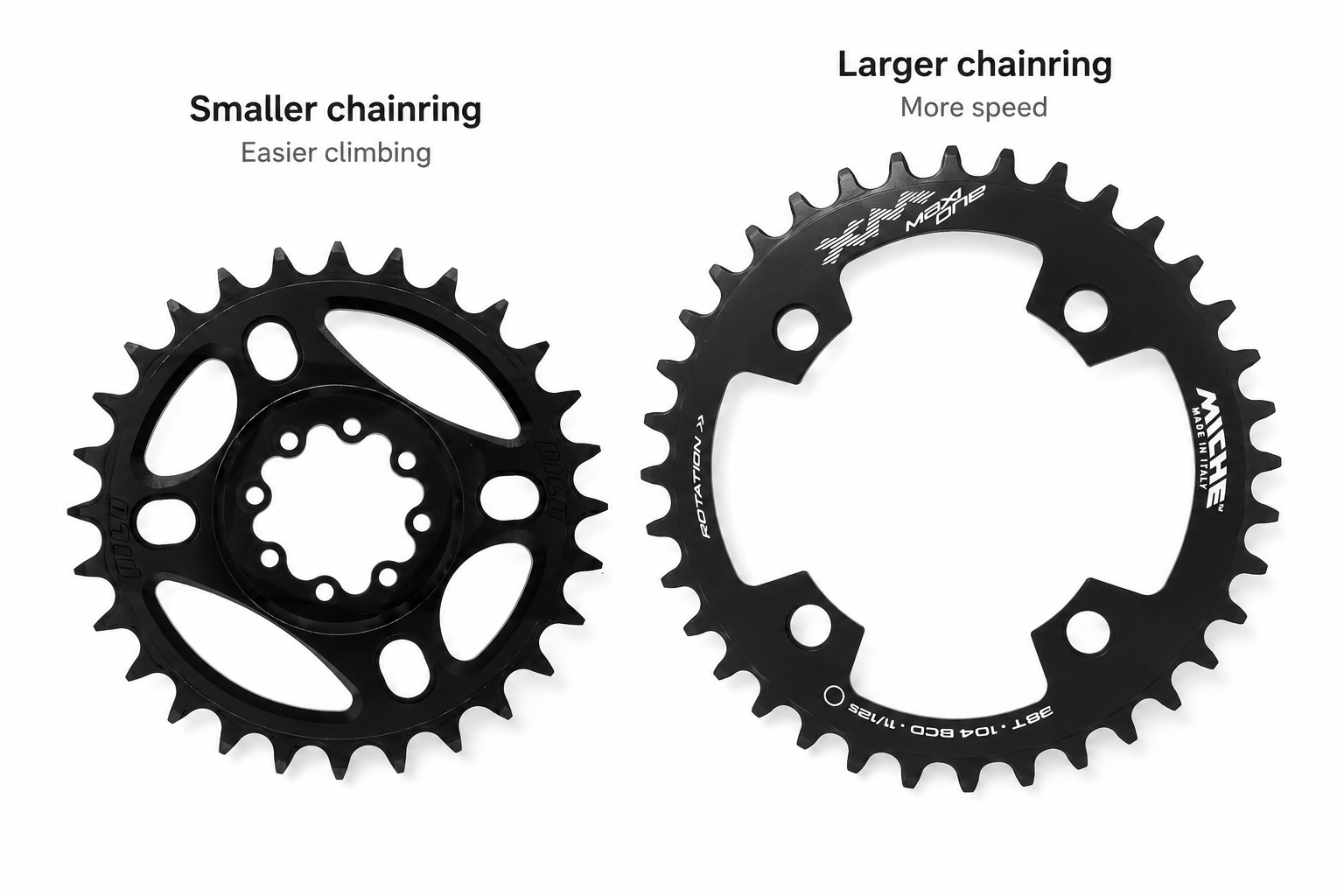
Simple rule: a smaller chainring helps you climb; a bigger chainring helps you ride faster on flat roads and descents.
1x, 2x and 3x Drivetrains: Why It Matters
Your drivetrain setup is one of the first things to check before choosing a chainring.
1x Drivetrain
A 1x drivetrain has one front chainring and no front derailleur. This setup is popular on MTB, gravel and many modern e-bikes. For 1x systems, a narrow-wide chainring is usually the best choice because it helps keep the chain secure.
2x Drivetrain
A 2x drivetrain has two front chainrings. These chainrings usually need to work as a matched set. The ramps and pins on the chainrings help the chain move smoothly between the small and big ring.
3x Drivetrain
A 3x drivetrain has three front chainrings. These are common on older MTB, trekking and touring bikes. Correct chainring size, bolt pattern and shifting design are very important for good front shifting.
Narrow-Wide vs Standard Chainrings
The tooth profile is just as important as the size.
Narrow-Wide Chainrings
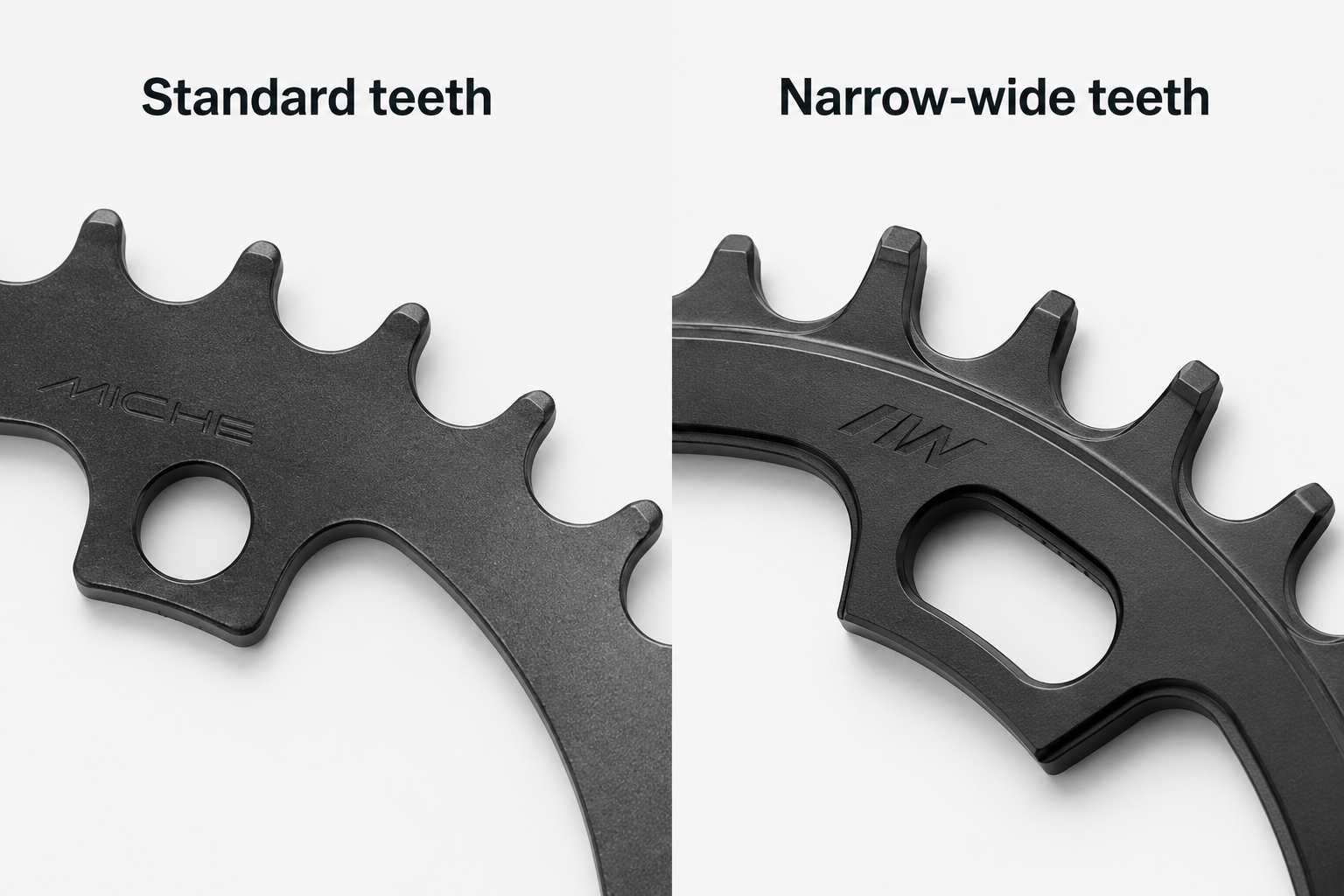
A narrow-wide chainring has alternating narrow and wide teeth. The tooth shape matches the inner and outer links of the chain. This gives better chain retention, especially on rough terrain.
Narrow-wide chainrings are best for:
- 1x MTB drivetrains;
- 1x gravel bikes;
- e-MTB and e-bike drivetrains;
- riders who want fewer chain drops;
- rough trails and technical terrain.
You can browse narrow-wide options by crank type, including SRAM chainrings, SRAM T-Type chainrings, Shimano direct mount chainrings and 104 BCD chainrings.
Standard Chainrings
A standard chainring usually has teeth designed for front shifting. Many 2x and 3x chainrings also include ramps and pins to help the chain move from one ring to another.
Standard chainrings are best for:
- road bikes with 2x drivetrains;
- trekking and touring bikes with front derailleurs;
- older MTB bikes with 2x or 3x drivetrains;
- riders who need smooth front shifting.
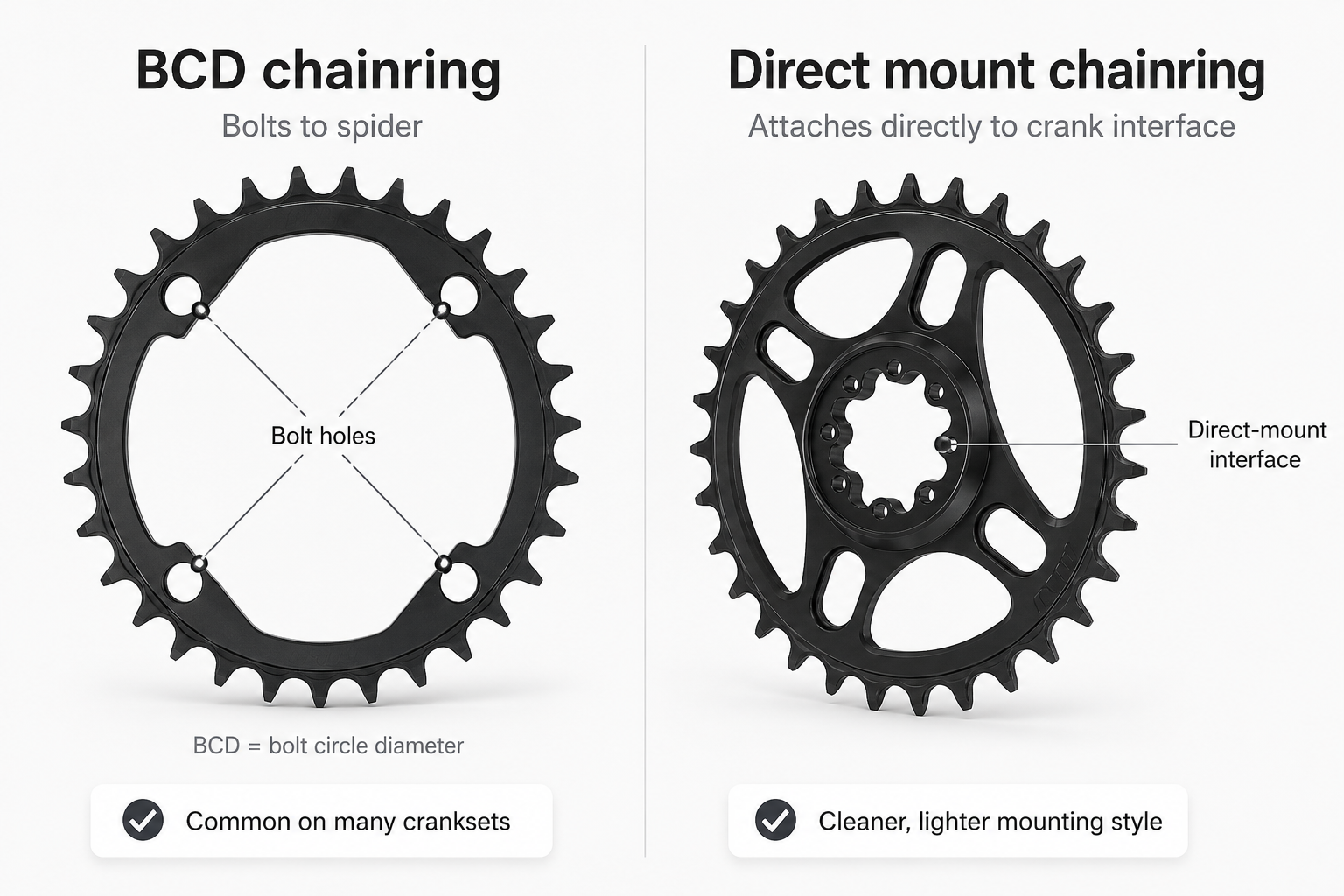
BCD Chainrings: What Does BCD Mean?
BCD means Bolt Circle Diameter. It describes the circle formed by the chainring bolts. If the BCD is wrong, the chainring will not fit your crank.
Common BCD types include:
- 104 BCD;
- 96 BCD;
- 96 BCD asymmetric;
- 94 BCD;
- 110 BCD;
- other brand-specific standards.
For example, Shimano-style asymmetric chainrings can look similar to standard 96 BCD rings, but the bolt position is different. Always compare the mounting shape carefully before ordering. You can check Elanus Parts categories such as 96 BCD asymmetric chainrings and 104 BCD chainrings.
Direct Mount Chainrings
A direct mount chainring attaches directly to the crank arm instead of bolting to a separate spider. This design can be lighter, cleaner and easier to change, but compatibility depends strongly on the crank manufacturer.
Common direct mount standards include:
- SRAM direct mount;
- SRAM 8-bolt T-Type;
- Shimano direct mount;
- Race Face direct mount;
- Cannondale and FSA direct mount;
- Bosch e-bike chainrings;
- e*thirteen direct mount;
- Middleburn direct mount.
If you are not sure which direct mount interface you have, remove the crank or chainring and compare the shape, spline, bolt pattern and offset. You can also browse by system in the Elanus Parts chainrings category.
Round vs Oval / Elliptic Chainrings
Most chainrings are round, but some are oval or elliptic. An oval chainring changes the effective gear size during the pedal stroke. Some riders like this because it can feel smoother on climbs and help maintain traction on technical terrain.
Oval chainrings are popular with MTB, gravel and e-bike riders who spend a lot of time climbing. However, the feeling is different from a round chainring, so rider preference matters.
If you want to try this setup, check the elliptic chainrings category.
Hyperglide+ Compatible Chainrings
Some modern Shimano drivetrains require chainrings designed to work with Shimano Hyperglide+ chains. If your drivetrain uses a specific chain standard, do not choose only by tooth count and mounting type. Chain compatibility also matters.
For Shimano 12-speed systems, check whether the chainring is marked as compatible with your chain and drivetrain. You can browse Hyperglide+ compatible chainrings at Elanus Parts.
How to Choose the Right Chainring: Compatibility Checklist
Before ordering, check these details:
- Number of teeth: choose smaller for climbing, bigger for speed.
- Crank fit: BCD or direct mount must match your crank.
- Drivetrain: 1x, 2x or 3x.
- Chain compatibility: 9, 10, 11, 12-speed, T-Type, Hyperglide+ or e-bike specific.
- Offset and chainline: especially important for direct mount and boost frames.
- Round or oval: choose based on riding style and preference.
- Bolts: make sure the bolt length and type match your chainring setup.
Expert tip: If two chainrings look almost the same, do not guess. Small differences in bolt spacing, offset or chain compatibility can make the chainring impossible to install or cause poor shifting.
When Should You Replace a Chainring?
Replace your chainring if you notice:
- sharp, hooked or “shark fin” teeth;
- chain slipping under power;
- frequent chain drops on a 1x setup;
- poor front shifting on 2x or 3x drivetrains;
- visible bending or damage after impact;
- new chain skipping on an old worn chainring.
A worn chainring can also wear out a new chain faster, so it is worth checking the whole drivetrain: chain, cassette, derailleur pulleys and chainring.
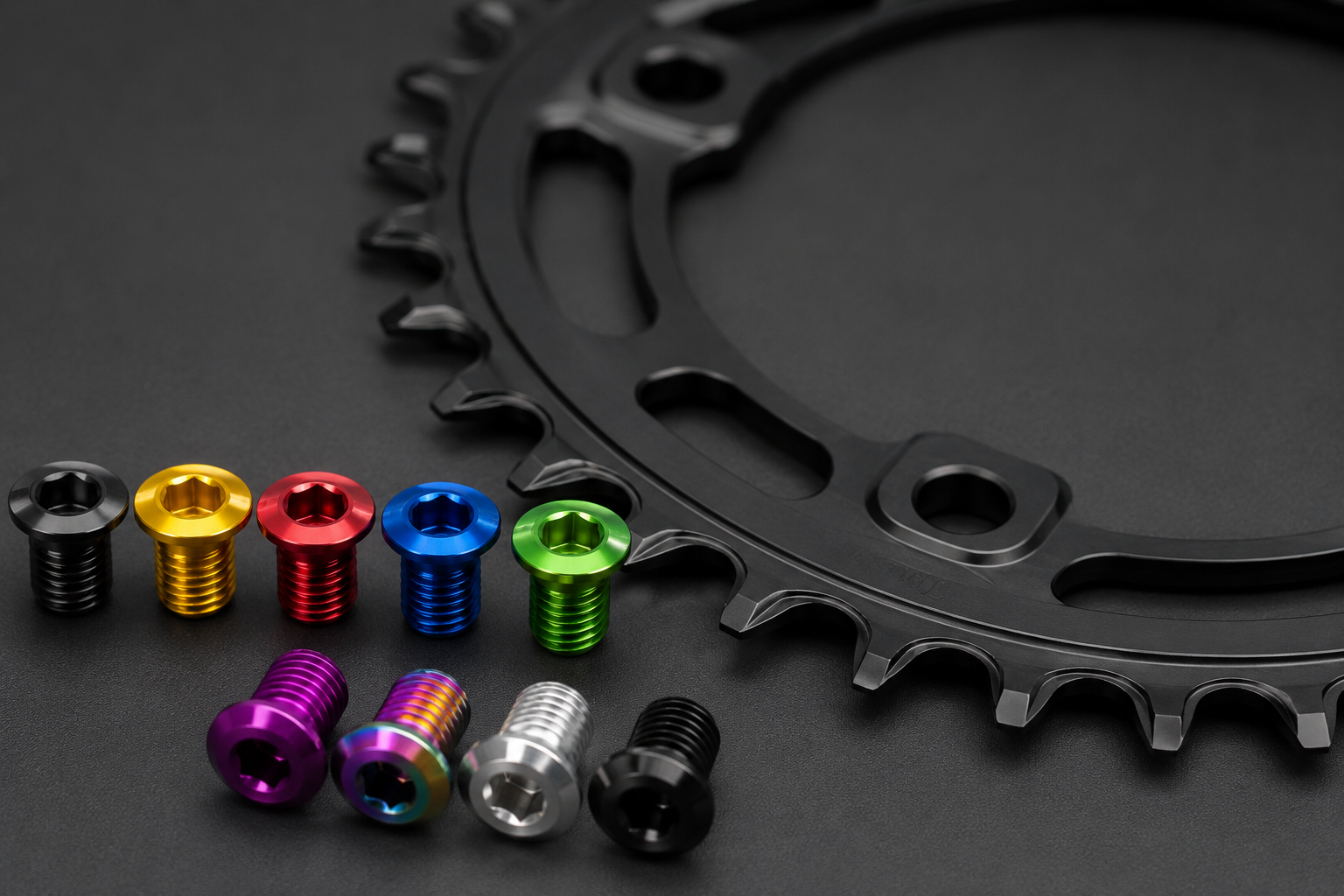
Do Not Forget Chainring Bolts
Chainring bolts hold the chainring securely to the crank. They may be small, but they are critical for safe and efficient power transfer.
Chainring bolts can differ by:
- length;
- thread type;
- single or double chainring use;
- material;
- tool interface, such as hex or Torx;
- color and finish.
Single chainring setups usually need shorter bolts, while double or triple setups may need longer bolts. If your bolts are damaged, too short, too long or corroded, replace them when fitting a new chainring.
For replacement and color upgrade options, browse Elanus Parts chainring bolts.
Best Chainring Size by Riding Style
| Riding Style | Recommended Size | Why It Works |
|---|---|---|
| Road / fast rides | 46T–52T+ | Higher speed on flat roads and descents |
| Gravel / commuting | 38T–44T | Good balance between climbing and cruising speed |
| MTB trail riding | 30T–34T | Better control and easier climbing |
| Steep MTB climbs | 28T–32T | Easier pedalling on technical climbs |
| E-bike / e-MTB | Depends on motor and drivetrain | Must match motor spider, chainline and chain compatibility |
Common Chainring Mistakes
- Choosing only by tooth count. A 32T chainring can have many different mounting standards.
- Ignoring BCD. 96 BCD, 96 BCD asymmetric and 104 BCD are not interchangeable.
- Using a non-ramped chainring on a 2x setup. This can make front shifting poor.
- Forgetting chainline and offset. This is especially important on direct mount cranks.
- Reusing damaged bolts. Worn or rounded bolts can make future service difficult.
- Mixing incompatible chains and chainrings. Always check speed and drivetrain compatibility.
Frequently Asked Questions About Chainrings
What does 32T mean on a chainring?
32T means the chainring has 32 teeth. A 32T chainring is common on MTB and trail bikes because it gives a good balance between climbing and speed.
Is a bigger chainring faster?
Yes, a bigger chainring can give more speed at the same pedalling cadence, but it also feels harder to pedal. It is better for flat roads, descents and strong riders.
Is a smaller chainring better for climbing?
Yes. A smaller chainring makes pedalling easier, which helps on steep climbs, technical trails and loaded touring or bikepacking routes.
Can I use a narrow-wide chainring with a front derailleur?
Usually no. Narrow-wide chainrings are mainly designed for 1x drivetrains without a front derailleur. For 2x or 3x systems, use chainrings designed for front shifting.
How do I know if I need BCD or direct mount?
If your chainring bolts to a spider with several bolts around a circle, it is a BCD type. If it attaches directly to the crank arm interface, it is direct mount.
Do chainring bolts come in different lengths?
Yes. Single chainring bolts are usually shorter, while double and triple chainring setups may need longer bolts. Always match the bolt length to your crank and chainring setup.
Are oval chainrings better than round chainrings?
Oval chainrings are a rider preference. Some cyclists like them for climbing and traction, while others prefer the familiar feel of a round chainring.
Common Chainring Questions
Is a bigger chainring always faster?
A bigger chainring can increase your top speed, but it is not always faster for every rider or route. Larger chainrings are better for flat roads, descents and high-speed riding, but they feel harder to pedal. If your route has steep climbs or technical terrain, a smaller chainring may actually help you ride faster overall because it is easier to keep a steady cadence.
What chainring size is best for gravel?
For most gravel bikes with a 1x drivetrain, chainrings between 38T and 44T are a good starting point. A 38T or 40T chainring is better for hilly routes, bikepacking and mixed terrain, while a 42T or 44T chainring is better for faster gravel rides and flatter roads.
Is 32T enough for mountain biking?
Yes, a 32T chainring is one of the most common choices for mountain biking. It gives a good balance between climbing ability and speed, especially when paired with a wide-range cassette. Riders who climb very steep trails may prefer 30T or 28T, while stronger riders on faster terrain may choose 34T or 36T.
Can I replace a 34T chainring with a 36T?
In many cases, yes, you can replace a 34T chainring with a 36T chainring, but you must check frame clearance, crank compatibility, chainline and chain length. A 36T chainring will give more speed but make climbing slightly harder. On full-suspension MTB frames and e-bikes, always check that the larger chainring does not touch the chainstay or motor cover.
Do I need a new chain when replacing a chainring?
Not always. If your chain is still within wear limits and runs smoothly, you may keep it. However, if the chain is worn, stretched or skips under load, it should be replaced together with the chainring. Installing a new chainring with a badly worn chain can cause poor performance and faster drivetrain wear.
How do I know if a chainring will fit my crank?
To check chainring compatibility, identify the mounting type first. BCD chainrings must match the bolt circle diameter and bolt pattern, while direct-mount chainrings must match the crank interface. Also check the number of speeds, chain type, offset and drivetrain setup before ordering.
Final Summary
- More teeth = higher speed, harder pedalling.
- Fewer teeth = easier climbing, lower top speed.
- Narrow-wide = best for most 1x MTB and gravel setups.
- Standard ramped chainrings = best for 2x and 3x front shifting.
- BCD or direct mount must match your crank exactly.
- Chain compatibility matters, especially for modern 12-speed systems.
- Correct chainring bolts keep everything secure and safe.
Need a replacement or upgrade? Browse bicycle chainrings, chainring bolts, SRAM T-Type chainrings, Shimano direct mount chainrings and Hyperglide+ compatible chainrings at Elanus Parts.
If you are not sure which chainring fits your crank, send us photos of your current chainring, crank model and drivetrain setup. We will help you identify the correct part.
Need Help Finding the Correct Chainring?
Not sure whether you need a 104 BCD, direct mount, SRAM T-Type or Shimano chainring? Send us photos of your current chainring and crankset and our team will help identify the correct replacement.
Comments (0)